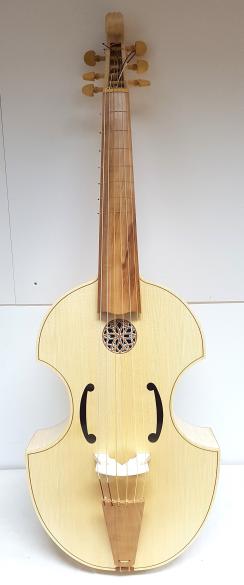
- There is no single undisputed original viol with a original soundboard from the 16th-century, that could serve as the basis for a faithful copy.
- Scientific studies assume that the soundpost only emerged in the second half of the 16th century. The use of the vertical bass bar (parallel to the wood grain) is closely related to the use of the soundpost.
- Around 1500, lutes enjoyed a very high reputation in aristocratic society and were highly valued. They were status symbols and their traditional static construction featured crossbars (cross to the wood grain) on the underside of the soundboard.
- Historical illustrations clearly show that fiddles, like lutes, have flat soundboards. A flat soundboard requires crossbars for the statik construction.
All of these facts together formed the basis for my design of a Renaissance gamba around 1500 with bars cross to the wood grain without a soundpost.
The stringing was of course completely in gut! After some searching the strings came off Luke Challinor proven.
Unlike the baroque viols, which have a voluminous, more bass-heavy sound due to their soundpost construction, this early Renaissance viol harmonizes perfectly with Renaissance lutes or other musical instruments of its time due to its design.
However, due to the static construction with cross bars, the acoustic performance decreases towards the low frequencies. The deep bass range did not play a major role in the music for the viola da gamba around 1500. The musical expansion into the bass range with the same instrument size only became more important later. (In the case of lutes, the expansion of the bass register began in the middle of the second half of the 16th century. Slightly earlier, the soundpost construction became established on bowed instruments).
For bowed instruments with crossbars, I don't see any constructive solution for the path to a functioning larger bass register or a more voluminous sound that was intended at the time. For this reason, a new construction had to be developed. The exact, gradual development process, which varied depending on the region and time, away from the flat sounboard with crossbars is unknown to us.
He ultimately led to the statically advantageous construction with a vaulted top and a vaulted back (which allowed for a lower material thickness), carved from a thick piece of wood, with a bass bar running along the grain (for a more resonant bass) and a movable sound post in the treble area below the bridge, which was necessary for stability. Additionally, it enabled the connection of the top and back. The big advantage of this design with a movable sound post is the possibility of subsequent sound correction. The construction of the string instruments of the violin family as we know them today was born.
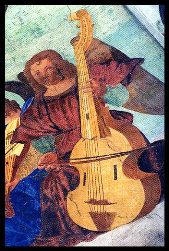
The following historical illustration has served as a template:
The Coronation of the Virgin, Ferrara, Italy, Fresco c.1510-15, partial detail of the Angel's Concerto
Monastery Church: Chiesa Santa Maria della Consolazione
Allegedly by vermutlich Michele Coltellini oder Baldassara Cassari